Friday, January 16, 2015

Dancing Legs Quiz 4

It is only right that we should pay homage to the choreographers who helped bring great dance to the silver screen. 

Name the choreographers and their partners. Bonus if you can name the movie in which they are dancing.

1) 


2) 
Note: The above film was actually filmed in Technicolor. The best pic I could find of their legs, however, was this publicity photo.

Tuesday, January 13, 2015

10 Classic Films for 2015

At the beginning of each year, Laura at Laura's Miscellaneous Musings puts together a list of ten films she plans to see during the new year. I thought this was a grand idea--what a wonderful way to ensure you are exposed to some new movies while checking off others that you have long been wanting to see! 

I searched my new DVD collection sets (my Christmas gifts were Classic Hollywood themed--yay!), the books I am reading/plan to read, AFI lists, and other classic film fans' opinions to help compile my list. After going back and forth a few times, here is the final list I resolve to see by the end of 2015:
1) American Madness (1932) - I received a Frank Capra set a few years ago, and this is the only movie I have yet to see. I typically enjoy "Capra-corn." Bonus: The movie is pre-code. Seems like a winning combo.
2) My Man Godfrey (1936) - I saw the very beginning of this film but got busy and was not able to finish it before it was removed from TCM On Demand. It looked promising. Plus it stars Carole Lombard and William Powell, two favorites.

The next four are inspired by the books I am either currently reading or plan to read before the year is up.
3) The Impatient Years (1944) - Jeanine Basinger wrote about this movie in I Do and I Don't: A History of Marriage in the Movies. It stars Jean Arthur and looks at what happens when a GI returns home to a wife he hardly knows. In a way, the film picks up where many early WWII movies (such as The More the Merrier, also starring Arthur) leave off. Intriguing. I just hope I can find a copy of this on DVD! Any leads would be welcome.

Friday, January 9, 2015

Dancing Legs Quiz 3

These dancers could strike a pose like no other. With beautiful lines, their dancing was art in motion. 

Name these renown dancers. Extra points if you can name the movie in which they are dancing.


1) 

Tuesday, January 6, 2015

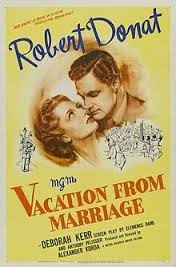
Vacation from Marriage (1945)

***This is an exception to my no play-by-play rule. Warning: spoilers abound.***

Posted prominently on the fabric bulletin board above my desk is the phrase: "Never be afraid to try something new." It serves as a reminder to always seek adventure and new opportunities. In terms of marriage, it evokes images of Nick and Nora Charles as they go wherever the leads take them with cocktails in hand and a quick quip to lighten any misstep. In their eyes, the risk of adventure is worth the humor and affection it brings. And along the way, they catch a crook or two.

 The antithesis of Nick and Nora would be Cathy (Deborah Kerr) and Robert Wilson (Robert Donat) in Vacation from Marriage (1945; known as Perfect Strangers in Britain). The couple's life is an unending dance of drudgery:
Cathy - Opens window. Sneezes. Passes shirt collar through the door. No word spoken. Picks up newspaper from doorstep. Places on table. 
Robert - Comes out of bedroom. Changes date on calendar. Adjusts the time on the mantle clock. 
At breakfast table - Lifelessly stare at each other. No word spoken.

Reality of marriage. No glamor girls or Hollywood hunks here, folks. 

Friday, January 2, 2015

Faboulous Footwork Friday

Quiz 2

Continuing with our celebration of dance in the movies...Can you guess the owners of these famous gams? Bonus - Name the movie in which they are dancing.


1) 


Wednesday, December 31, 2014

Just for Fun ~ Fabulous Footwork Quiz

Let's dance in the new year and celebrate great choreography in the movies. Can you guess the owners of these famous gams? Bonus - Name the movie in which they are dancing.


1)


Wednesday, December 24, 2014

New Year Reflections ~ Life's a Banquet

I'll be honest. Auntie Mame (1958) is not part of my annual holiday lineup. I prefer to save this film for a day when life has got me down, and I "need a little Christmas," as Mame of the musical version would say, "Right this very minute!" Maybe subconsciously I know this is how Mame would intend her film to be used--should characters be able to hop the fourth wall and converse with their audience.

Nonetheless, this year Auntie Mame (Rosalind Russell) keeps popping into my head. I desperately wanted to finish an email reminder to read over Winter Break with Mame's famous line, "Life's a banquet, and most poor suckers are starving to death!" I refrained, knowing that most parents and students would not get the reference and might focus too heavily on the "sucker" part. Here, however, I can share the line and know my readers will delight in the line as I do. Mame's advice is wise--there is so much to learn if only one opens his/her mind (or for the purpose of my email, opens a book) and applies his- or herself.

Wednesday, December 17, 2014

Hope in the Night

http://en.wikipedia.org/wiki/Remember_the_Night
Remember the Night (1940) and I met quite by accident. One might think between my affinity for Fred MacMurray, admiration for Barbara Stanwyck, and passion for all things Christmas, I would have discovered this holiday film years ago. Alas, I happened to flip on the channel, and there it was, waiting for me. Kismet. 

At first I questioned the premise. An attorney (Fred MacMurray) taking home a thief (Barbara Stanwyck) over the holidays? Really? Who would do that? But as I continued watching, the film pulled me in. There is a much deeper message than the surface summary would have you believe. The story is about the difference between being on the wrong versus the right side of the tracks, and what that can do to one's spirit.  

Sunday, December 7, 2014

I Feel Pretty - The Musical Side of Beauty

Keeping with last week's theme...

Movies have also taught us that glamorizing oneself is part of the fun of womanhood. Being a musical-lover, I can think of several films in which young women joyfully sing about the benefits of being a female--and a beautiful one at that. 

Here are three that come to mind:

West Side Story (1961) - "I Feel Pretty"


Flower Drum Song (1961) - "I Enjoy Being a Girl"   


Bye Bye Birdie (1963) - "How Lovely To Be a Woman" 


Sunday, November 30, 2014

Beauty for Sale

Watch any television program with a high female demographic or flip through a magazine intended for women, and you will be bombarded with countless ads peddling beauty wares. The desire for immortality is as old as Ponce de Leon's search for the Fountain of Youth, but the added emphasis on female beauty is what has survived to current times. 
 From far left (clockwise) - Virginia Mayo, Ann Blyth, Gene Tierney, and Judy Garland

Attaining the idealized vision of beauty is not an easy process, no matter what the age (although the time to get ready seems to correlate with how old you are). There is much work to be done. Plucking of eyebrows, manicuring of fingertips, pedicuring of toes. Straightening of curly hair. Curling of straight hair. Mascara. Lipstick. Blush. Bronzer. Moisturizers, cleansers, anti-aging serums. Creams. Creams to tighten skin, creams to get rid of bags under the eyes, creams to prevent acne. And let us not forget the diets. Atkins diet. South Beach diet. Anti-carbohydrate diet. If all else fails, there are also body shapers: corsets, girdles, and spanks--oh my!

Sunday, November 23, 2014

Kicking off the Holiday Season ~ Holiday Inn

It's Thanksgiving week which means the countdown to Christmas has begun (although if commercials and store decorations are any indication, the shotgun was fired the day after Halloween). While some might hum and hah like Ebenezer Scrooge, I am one of those silly souls who can't wait to switch the station to 24/7 holiday music, deck the halls, and compile the holiday movie viewing list. Since Christmas movies in November can transform my hubby into a humbug, the first film of the season must be carefully chosen. This means the flick cannot be strictly classified as a "Christmas" movie. The answer to this conundrum: Holiday Inn (1942). 

http://en.wikipedia.org/wiki/Holiday_Inn_%28film%29
What better way to kick off the holiday season than by watching a cinematic celebration of the year's holidays?

Friday, November 14, 2014

Fools for Scandal

The real scandal may have nothing to do with them.
I love Carole Lombard, Paris, quick witty dialogue, and light fluffy comedies. When I saw Fools for Scandal (1938) come across my Facebook feed, promising all of the above, I thought I had a sure winner. DVR set to record. Unfortunately this movie fell flat. Very very flat. Old champagne flat. I'm usually much easier to please. (Yes, I see messages in movies, but that does not interfere with my enjoyment of the films.)

What went wrong? Maybe my expectations were too high. Maybe it was the lack of chemistry between Lombard and her co-star Fernand Gravet (or the fact I was expecting Robert Montgomery--I swear the pic looked just like him--and got Gravet). Then there was that awkward attempt mid-movie to become a musical although no characters had spontaneously burst into song up to nor following that point.

To stay on the sunny side of the street, I did find one interesting nugget in my viewing. For being made after strict enforcement of the Hays Code, the movie is rather suggestive regarding two of the female characters in the cast: Lady Paula Malverton (Isabel Jeans) and Jill (Marcia Ralston). In hindsight, the foreshadowing is present before the camera first presents the ladies together. The main characters, Kay (Lombard) and Rene (Gravet), walk into the restaurant where Lady Paula is giving a party, and this is the act on stage:


Notice the woman dressed in traditional male attire 
among the other women who are dressed in beaded gowns.


At first glance of the table, Jill appears to be a male character. Her hair is slicked back and her outfit is distinctly masculine in nature. Lady Paula discusses how she has taken Jill to Paris and is paying for her French lessons. 

Jill's style remains masculine throughout the picture. At Kay's masquerade party, she again can be mistaken for a man:


Lady Paula leads Jill to another room away from the party. 

Among the ladies in the spaghetti strapped and backless gowns, she is dressed in a short sleeve, buttoned up shirt, black vest, and long pants.

Lady Paula discusses Rene's finer points. 
Jill appears amused and Kay surprised.


After the party breaks up, the two women leave together. Lady Paula, however, wants to go back into the house to investigate Kay and Rene's true relationship.


Jill looks worried. Afraid to lose her friend to Rene perhaps? Maybe to Kay?

The next morning, the city is aflutter with gossip (thanks to Lady Paula) that Kay is living with a bachelor. The ladies gather to ply Kay with questions:


In walks Jill, her masculinity exaggerated by the fact that once more she is surrounded by the ultra-feminine gals.


The remainder of the movie focuses on the main characters, leaving Lady Paula and Jill to their devices off-screen, which honestly would have been more interesting. 

While I would not recommend watching Fools for Scandal for entertainment purposes, it would be an interesting view if only to see how Hollywood treated lesbianism under Breen's watchful eye.
 

Thursday, November 6, 2014

'60s Career Girls and Marriage

And now it is time to wrap up my Career Girls and Marriage series (although the more I watch, the more I want to add--I may need to revisit in the future). 

Onto the 60s, a tumultuous time of conflicting identities:
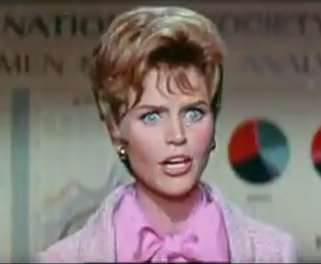
  • Wheeler Dealers (1963) - In this film, career women are presented as two types: the ones who work in order to find a husband and those who work because they find fulfillment in their job. Molly Thatcher (Lee Remick) is one of the latter while her roommate Eloise (Patricia Crowley) is of the former, working uptown where it is easier to bag a husband. Molly, on the other hand, works downtown where a girl has to be "twice as smart to get half as far." Interesting observation of the glass ceiling. Molly wants to be a respected business woman, but her working environment is less than conducive to her desires. Although she is unaware of it, her bosses are trying to fire her with the rationalization that hiring a female employee was just an "experiment" anyways.
    She belongs to a lunch club, which is full of women who want to move up in the world, yet is managed by men. Apparently the men have not received the memo as they prefer to discuss facts about bobby pins and kitchen appliances as opposed to the facts and figures of Wall Street.
    Molly challenges the club's male speaker; she is insulted that women are not being taking seriously in the work world and are considered emotional and "excitable." What a rally cry! The irony, however, is that the women are portrayed as emotional and excitable at the very time she is delivering her message. One step forward, two steps back. To top things off, Molly is relentlessly pursued by the rather handsome Henry Tyroon  (James Gardner...sigh...) who has plans to make her his girl. Along the course of the way, she informs him (and us) that she prefers to be admired for her intelligence, not her beauty.
    She also explains that even if she got married, she would hold off on having a baby because that would end her career. Wow--a different reality back in the '60s! (Yet, I can't help wondering how far we have come. Some hypothesize that motherhood still has a negative effect on career advancement.*)
    Molly can predict Henry's every move and successfully resists. Almost. In the end, her plans change. Molly is going to marry Henry and move back to Texas with him.
*See Sarah Hoye's (CNN), Jayita and Murali Poduval's (National Institute of Health), and Lisa Quast's (Forbes) articles for more info on this topic.

  • The Thrill of It All (1964) - This week brings us two James Gardner movies (double sigh). During my first viewing, I thought, Oh I like this one--a light, fun movie with a working mother at its center. I still enjoy the movie. I can relate--as I imagine many working moms can--to that torn, guilty feeling of not always being there to for all the little moments in our children's lives. At the same time, I can understand why Beverley Boyle (Doris Day) enjoys her job. She is her own woman, able to contribute to the household fund for the first time. As an added bonus, she gets to communicate with other adults.
    The last straw... Source
    While she revels in her new spot on the financial food chain, her husband Gerald (James Gardner) becomes more and more irritated with her career. She is neglecting her duties on the home front such as having his dinner ready and saying good night to the children. The situation escalates until finally both decide it would be better for her to give up her career and solely be a mother and wife. She seems pretty pleased with the decision. In fact, the ending implies that she is going to have another baby. (Because babies solve all major conflicts at home, right?)  
  • Sex and the Single Girl  (1964) - This movie chronicles the fictional version of Dr. Helen Brown (Natalie Wood), a psychologist who has written a book about being single and living like man; i.e. sex with whomever and whenever you wish, and the rat, Bob Weston (Tony Curtis) who is trying to secretly publish an article documenting what kind of woman she is. (Remember, the message goes that there are two kinds of women--those who do and those who don't.) Bob is not the only one who desires this knowledge. Helen's co-worker Dr. Rudy DeMeyer (Mel Ferrer) also indicates that he is dying to know her type and essentially tells her that he hopes their elegant evening together pays off. So if a guy provides a nice date, you have to put out? Wowzers--this is a message for further exploration! (Not to mention how he keeps coming on to her after she has clearly expressed disinterest in his advances... Sexual harassment in the office, anyone?) Helen is full of contradictions.
    She declares, "Married! I don't want to be married! I've got work I care about much more." Yet she believes that
    men have the "opportunity, challenge, and responsibility" to marry as this is the only thing that sets humanity apart from animals. By the end of the flick, Helen rocks a stuffed animal as though it was a baby and realizes, "I don't want to be a single girl!" She gives up her practice to marry Bob. The sentiment of the movie can be summed up in two quotes: 
    A tongue-and-cheek statement by Gretchen (Fran Jefferies), Bob's girlfriend (if you can call her that--she is more of a booty-call), "I wouldn't give up my career for marriage, kids, and happiness." True happiness lies in marriage for women. 
    Acted with mock enthusiasm, Bob announces to a co-worker, "You may have power, money, and sex. But I've got love!" Bob's declaration is part of a joke. Love is not what men want. Marriage is a trap. Just ask his neighbor, Frank Broderick (Henry Fonda), who regularly dodges objects thrown at him by his ever jealous wife Sylvia (Lauren Bacall).

And with that, the series on Career Girls and Marriage is concluded--for now. Thank you for reading! Please feel free to comment or email me with titles of movies that deal with career and marriage. I would love to explore this topic further and welcome anomalies to the standard Hollywood message.