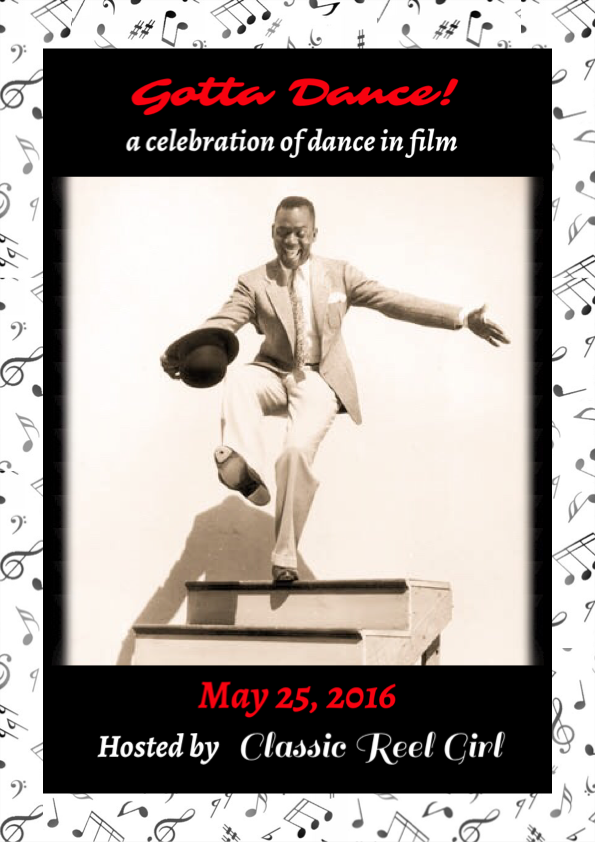
Get your dancing shoes ready because the Gotta Dance! Blogathon has arrived!
The Task
Celebrate #NationalTapDanceDay and the great Bill Robinson and Fred Astaire with a post that celebrates dance in film. Everything is game: choreography, dancers, music, partnerships, style. The important ingredient is fun!
The Menu
Sit back and let us razzle dazzle you with these copasetic posts:
This entry is part of the Gotta Dance! Blogathon hosted by Classic Reel Girl on May 25th. Click here to view more fabulous entries celebrating dance in film.
~ ~ ~
On Wednesday, May 25th, we celebrate National Tap Dance Day and the birth of the King of Tap himself, Bill "Bojangles" Robinson.
Today, Robinson is best remembered for the four films he made with Shirley Temple. He has been both praised and criticized for his part in these movies. Praised for breaking race barriers when he andTemple became the first interracial dancing duo to grace the silver screen. Criticized for taking "Uncle Tom" roleswhere he portrayed servant, slave, butler, and overall protector of a little white girl.
Pick five classic films you would want to have with you if stranded on a deserted island.
Whittling
my beloved film collection to only five was no easy task. Which movies
would I be content forever replaying in my head because I know every
line and move by heart? Which movies would I want the full film
experience? I needed some criteria.
This post is part of the Star-Studded Couple Blogathon hosted by Phyl over at Phyllis Loves Classic Movies. Click here to read more fabulous posts about star couples.
Marge and Gower Champion were a popular dance team during the 1940s and 1950s. The married couple co-starred in seven films, made numerous television appearances, had their own television series, The Marge and Gower Champion Show, and even wrote a book on how to dance.
May is an important month in the world of dance. Two greats were born: Fred Astaire on May 10, 1899 and Bill "Bojangles" Robinson on May 25, 1878.In honor of these great dancers and National Tap Dance Day--which coincides with Robinson's birthday I will host my first ever blogathon:
Gotta Dance! May 25, 2016
Come join me in celebrating all things dance: the choreography, the dancers, the music, the partnerships.
*To get to know a star whose films you have not widely viewed (max three prior to blogathon) *View at least five of their films and report back
Who I picked and why
After consulting Constance Valis Hills' Tap Dancing America and checking to see if there were enough films available for viewing, I selectedGeorge Murphy for the Marathon Stars Blogathon. According to Hills, Murphy is one of the "Irish Princes" who brought the vaudevillian and popular stage tradition to the big screen.
What better month to celebrate the Irish actor than in March?
A combination of prep work for this year's Dancing Legs quizzes and a star search for In the Good Old Days of Classic Hollywood and The Wonderful World of Cinema'sMarathon Stars Blogathon brought me to the sad realization that many of the world's greatest tap dancers are missing from our public consciousness and film library. Dancers who made possible the likes of Fred Astaire, Hermes Pan, and Eleanor Powell but were pushed aside due to the color of their skin. Dancers who were as talented as Ann Miller or Gene Kelly
but never given a fighting chance in Hollywood. Instead their dance routines are limited to decaying film reels or descriptions in a textbook. Today's post is a small step in trying to ensure their legacy is not lost. For the record, I strongly believe that the celebration of these dancers should not be limited to one day or even one month of the year. I plan to make a concerted effort throughout 2016 to view the rare film appearances of these incredibly talented dancers.
Jeni LeGon
Jeni LeGon was a solo tap dancer whose athletic movements were every bit as good as the male dancers of her day. After dancing with Bill "Bojangles" Robinson in RKO's Hooray for Love (1935), she scored a contract with MGM. According to dance historian Constance Valis Hill, LeGon was slated to perform in Broadway Melody of 1936, an Eleanor Powell star vehicle, but was taken off the assignment after LeGon "stopped the show" at a promotion event that included Powell. Per LeGon in 2006:
It was a color thing. They said they couldn't use two tap dancers, but that was bull corn.
From then on, MGM neglected her talent, opting to put her in servant roles instead. The biggest snub must have been when she played maid to dancer Ann Miller in Easter Parade (1948). It is a crime that her dancing skills were squandered.
Jeni LeGon and Bill "Bojangles" Robinson in a publicity shot for Hooray for Love (1935) Click here to sample their dancing.
Part of 10 for 2015 From the first number, Torch Song gets off on the wrong foot. While Joan Crawford's legs are exquisite, they dance to a song, "You're All the World to Me," already covered by Fred Astaire's feet two years earlier in Royal Wedding (1951). It's not likely audiences would have forgotten the number either--he dances on the walls and ceiling.
The opening shot of Crawford's gams attempts to establish her great musical comeback. The dance that follows is lackluster.
On August 5th, TCM will celebrate one of the greatest--if not THE greatest--dancers to ever grace the silver screen: Fred Astaire. While the plots of his films are sometimes criticized for their (delightful) fluff, one aspect that cannot be disputed is the dance. Ever the perfectionist, Astaire's technique is flawless. His choreography, often created in collaboration with Hermes Pan, is inventive, utilizing the new medium of film to take dance to a level not possible on stage. As a dance partner, he is generous, allowing his female counterpart to shine, but he also ensures a solo in the film to showcase his own skills.
And that quibble about plot? Sure, the overall material is light, but the songs and dances are not randomly placed entertainment to be burst into at any time. They further the plot and the relationship between the characters--a revolutionary idea when Astaire first arrived on the scene in the early 1930s. Watch how Astaire enters a dance. He walks into it, allowing the music to gradually pull him to the steps as in "Smoke Gets in Your Eyes" (Roberta). Or his dialogue gradually shifts into song as he begins to talk-sing the lyrics as in "Let's Call the Whole Thing Off" (Shall We Dance). The dance becomes an extension of the story's action and dialogue. It reveals the characters' personalities or conflicts they are experiencing. By the end of the number, for better or worse his relationship with his dance partner has evolved.
Without further ado...
Whether you've seen his films hundreds of times or can't get past the plot and need to fast-forward (for shame!) to the good stuff, here is a list of dances that you should view to understand the greatness of Fred Astaire. For the sake of keeping this post a manageable length, I will highlight one number from each movie that will be shown on August 5th, but honestly I could have included two or three per film. This was difficult!
~ ~ ~
1) Flying Down to Rio (1933) ~ 6 am ET/ 3 am PT
The Dance: THE CARIOCA
Why you should see it: The number captures the state of dance in the early '30s (Busby Berkeley-ish inner circle, focus on geometrical patterns) and hints to where dance was going (the outer circle, focus on "real" dancing). The choreography was the brainchild of a then unknown Hermes Pan. Credit is due to Astaire who recognized Pan's talent and paved the way for the young choreographer in the business. This is also the number that started the whole Astaire-Rogers craze.
~ ~ ~
2) The Gay Divorcee (1934) ~ 7:30 am ET/ 4:30 am PT
The Dance: THE TABLE DANCE
Why you should see it: Astaire and Rogers kick it up a notch when they whirl up and down a tiny table and chairs. It's an amazing feat of balance, rhythm, momentum, and grace. The space is small and a single misstep could cause them to tumble to the ground. Astaire originally performed THE TABLE DANCE with Claire Luce in The Gay Divorce, the play on which the film is loosely based. According to Astaire, this "swell trick" did in fact result in "many a fall rehearsing [...] and occasionally [Luce and Astaire] fell during the show, too" (176). Thank goodness the "trick" was preserved in this film, so we can enjoy a piece of old Broadway.
~ ~ ~
3) Roberta (1935) ~ 9:30 am ET/ 6:30 am PT
The Dance: SMOKE GETS IN YOUR EYES
Why you should see it:This is the first romantic number Astaire choreographed for himself and Rogers. It is relatively simple compared to the 18-step staircases and skates to come, yet there is an intimate quality to the dance--more is professed in step than any spoken love scene. The couple enter arm in arm, heads together. Only the tune can break their hold. At
one point Astaire reaches for Rogers but resists his urge to touch her, bringing
his hand towards is heart instead--a sense of his character's unfulfilled
desire. As they dance they are one with the music, movements reaching crescendo as the song does. The music softens, and Rogers puts her head on Astaire's shoulder. In response, he gently places his hand over her head. A tender exchange has occurred without dialogue, but in case anyone needs to hear the words, the next scene solidifies it: he has proposed and she has accepted.
~ ~ ~
4) Top Hat (1935) ~ 11 am ET/ 8 am PT
The Dance: CHEEK TO CHEEK
Astaire versus Rogers' feathered dress
Why you should see it: Astaire demonstrates how to handle on-the-job complications with dignity. Per the star of the day:
The dancing dresses of my partners have, for years, been a working problem, and in Top Hat I dare say it reached its dizzy peak. (207)
When Rogers began to dance, feathers flew everywhere--over the floor, on Astaire's clothes, and in his face. Astaire was NOT happy, but maintained composure and danced on. Neither Astaire's frustration nor the flying feathers could be perceived on film, so all ended well. Later (off screen), Astaire lightened the mood by singing a new version of "Cheek to Cheek" to his dance partner:
Feathers--I hate feathers--
And I hate them so that I can hardly speak,
And I never find the happiness I seek
With those chicken feathers dancing
Cheek to Cheek. (210)
In her autobiography, Rogers recalls that Astaire also gave her a feather bracelet charm as a peace offering. What a gentleman!
Why you should see it:Astaire and Rogers play working-class folk and their dancing reflects it. The movements in this number are more down-to-earth jazzy than sophisticated ballroom. Instead of standing erect, shoulders back, arms outstretched, Astaire and Rogers let loose. They throw their bodies around, clap their hands, jump heels-first into steps, and Astaire even tosses Rogers onto his hip. They are approachable, the guy and gal who might live next door. The couples they "compete" with are actual dance contest winners, which further give Astaire and Rogers an accessibility not felt in prior films.
Another number to check out - Astaire's battle with Rogers' beaded sleeve in LET'S FACE THE MUSIC AND DANCE. Those who don't know the story: Rogers' heavy sleeve whacked Astaire in the face, leaving him "knocked groggy" (his words). Despite retakes, the first--with the sleeve slap--was the best and is the one we see in the film today. Bonus: the beautiful art deco set and the story that unfolds within the dance, which is part of a play in the film
~ ~ ~
6) Swing Time (1936) ~ 3pm ET/ 12pm PT
The Dance: NEVER GONNA DANCE
Why you should see it: Astaire emotes his character's anguish through dance. It's near the end of the movie and the outlook is dreary. Astaire has lost his girl. As he walks beside her, his body language pleads for her to dance. She consents (this is an Astaire-Rogers movie after all!). The music and movements recall earlier parts of the film, and Astaire and Rogers expertly move through the changing tempos. The result is a dance that summarizes what has occurred between the characters. It is his final attempt to win her back through shared memory, but it does not work. In a final turn, she briskly walks away, leaving him to himself. Shoulders slumped, he is alone and dejected.
Astaire and Rogers' flight up the 18-step staircase is another reason this number is impressive. They didn't merely ascend face-forward--they spin too! Legend has it that the duo danced up the steps 40+ times. This may be an exaggeration. They reshot 48 times; however the bulk of the retakes were after Astaire and Rogers already reached the top of the staircase. According to Pan, the last sixteen bars is where they ran into difficulties (Franceschina 78), and Rogers' account supports this when she states they "danced and danced and danced" on the second floor (194). In her book about Astaire and Rogers, Arlene Croce explains the camera angle moves to a stationary shot at the top of the stairs, ending the continuous take--which is how Astaire preferred to have his dances filmed--because the dance's "climax, a spine-chilling series of turns by Rogers, took forty takes to accomplish" (113).
If you look closely, you can see the cut towards the end of the dance, where Pan and Croce indicate the team began retake after retake.
Left: continuous crane shot - Right: second floor stationary shot
~ ~ ~
7) Carefree (1938) ~ 4:45pm ET/ 1:45pm PT
The Dance: SINCE THEY TURNED 'LOCH LOMOND' INTO SWING
Why you should see it: People who are in the know about golf say this Astaire solo is impressive. He makes swinging a golf club and hitting the ball look effortless though it is much more difficult than non-golfers might think. How did he make it look so easy? Lots of practice on the golf course, of course!
I had about three hundred golf balls and five men shagging them, a piano and Hal Borne to play for me, and several buckets of iced beer. (235)
No wonder the dancer stated this was one of his favorite solos.
~ ~ ~
8) The Story of Vernon and Irene Castle (1939) ~ 6:15pm/ 3:15pm
Why you should see it: Astaire and Rogers capture the signature dancing style of Vernon and Irene Castle on film. Compared to clips of the Castles, Rogers' front-facing kicks are higher and Astaire's footwork appears fancier, though the later is probably due to better film technology which adds clarity to the picture. Under Irene Castle's supervising eye (she served as technical advisor on the film), it would have been difficult to deviate from the original steps. Truth be told, it's nice to have an authentic recreation of the Castles' historically significant numbers.
~ ~ ~
9) Shall We Dance (1937) ~ 8pm ET/ 5pm PT
The Dance: LET'S CALL THE WHOLE THING OFF
Why you should see it: Always up for a challenge, Astaire joins Rogers on skates in a number that will leave you nostalgic for the roller rink. How many takes until they got it just right? 150 per studio records (Franceschina 88).
~ ~ ~
10) You Were Never Lovelier (1942) ~ 10:15pm ET/ 7:15pm PT
Why you should see it: Astaire swings! Well, sort of... Life magazine describes it as "[c]oupling ballet with jitterbug" (66), but that's close enough in my book. He gets down, shows his fancy footwork, then swings with Rita Hayworth to Xavier Cugat's band. Astaire and Hayworth respected each other's talents and enjoyed working together. It shows. The joy in this number is so infectious you might find yourself tapping along with Hayworth from the sidelines. She is soon on her feet, though, proving to be Astaire's equal on the dance floor.
~ ~ ~
11) The Band Wagon (1953) ~ 12am ET/ 9pm PT
The Dance: DANCING IN THE DARK
Why you should see it: Astaire leaves the tricks at home and performs an elegant dance with Cyd Charisse. Their movements mirror the music, arms hitting accent notes with long, beautiful lines and bodies rising as the notes get higher. Astaire dances in character. At the beginning of the number he watches his partner's feet, clearly pondering the question she asked two scenes earlier, "Can you and I really dance together?" Astaire does not turn off Astaire the actor to become Astaire the dancer. Astaire is dancer and actor at all times.
~ ~ ~
12) Silk Stockings (1957) ~ 2am ET/11pm PT
The Dance: ALL OF YOU
Why you should see it: The number contains elements of Astaire's previous dances, making it a fitting final salute to his dancing career in studio system movie musicals.* Reminiscent of the hat rack in Royal Wedding,he briefly dances with a chair. Like many of the routines from his and Rogers' films, the characters' conflicts are illustrated through dance. This time Astaire's Steve beseeches Charisse's Ninotchka to enjoy the capitalistic ways of dance and romance. He pulls her into the dance, she dances a little but tries to resist, and he persistently pulls her back again--similar to "Night and Day" in The Gay Divorcee and "Never Gonna Dance" in Swing Time. As Steve watches Ninotchka fall under the spell of dance, there are hints of Astaire's psychiatrist and Rogers' hypnotized Amanda from "Change Partners" in Carefree. This number is also evidence of Astaire's growth as a dancer. In Carefree,Pan had to coax Astaire into throwing Rogers over his legs during "The Yam" because Astaire did not believe he was built to lift. In both "All of You" and its reprise, Astaire performs several lifts with Charisse.
*He appeared in one last musical, Finian's Rainbow in 1968, but Silk Stockings was his final studio system era musical.
Why you should see it: You haven't lived until you've seen Astaire dancing on the ceiling! How was it done? Look away now if you don't want to dispel the magic or are determined to figure out the secret on your own. The room was built within a rotating barrel, the furniture was secured to the walls, and the cameraman was attached to a platform that rotated with the room. Meanwhile Astaire danced as the room revolved around him. Bravo to all involved!
Other numbers of note - In "Sunday Jumps" Astaire does an impressive number with a hat rack. "Open Your Eyes" is pulled from Astaire's real-life experience with his sister Adele when they performed on an ocean liner during a storm. We may not have Adele's dancing captured on film, but at least we have this memory.
~ ~ ~
This post is part of the 2015 TCM Summer Under the Stars Blogathon hosted by Kristen at Journeys in Classic Film. Visit her blog daily to read new posts on each star of the day.
Rogers, Ginger. Ginger: My Story. 1991. New York: Harper Collins, 2008. Print.
Photos without sources are taken by me. No copyright infringement is intended by the use of images shared on this blog. Images are used only to enhance or pay tribute, not intended for any commercial use. If you feel your copyright has been infringed upon, please contact me via email, and I will take down the image immediately.
Since the beginning, dance has been a part of the movies. Dance hall girls in particular can be found in films as early as the 1910s with such pictures asShould a Wife Forgive?(1915) andOne Touch of Sin(1917). Films such as the Joan Crawford's Taxi Dancer(1927)--her first top billing by the way--reflectedthe dance hall's evolution into a dime-a-dance establishment. At ten cents a song, dance hall patrons could select the "hostess" with whom they wanted to dance. (Employees were typically women, but there was the occasional establishment with male hosts. These would not make it to film.) Because their time was "rented" much like one might rent a taxi, these women were referred to as taxi dancers. For a society that had only recently accepted the idea of a man holding a woman closely in his arms while dancing, paying to do so was scandalous--a hop, skip, and jump away from prostitution. And yet it wasn't.Dance halls provided filmmakers a setting just dangerous enough to tantalize their audience but safe enough to show on screen without public protest.
In terms of taxi dancers and societal attitudes, two pre-code films that are interesting to consider are Columbia's Ten Cents a Dance (1931) and Warner Brothers' Two Seconds (1932). Released within a year of each other, they give distinctly different portrayals of dime-a-dance gals.
A little music to get you in the mood.
The song was written for Ziegfeld's Broadway musical, Simple Simon.
The musical was not a success. The song, on the other hand, was.
Ten Cents a Dance (1931)
Ten Cents a Dance was inspired by Richard Rodgers and Lorenz Hart's song of the same name. Written from a taxi dancer's perspective, Hart's lyrics bemoan the trials of the profession. Traces of the song can easily be found in the film resulting in a sympathetic portrait of the dime-a-dance girl.
The film gets straight to the point with Barbara O'Neill (Barbara Stanwyck) standing at the edge of a dance floor appearing bored. A sailor picks her up for a dance. He brags that his paycheck comes in tomorrow, but she is not impressed. Clearly he is not the first to try this line on her. She leaves the floor, claiming that she is wanted on the phone. In the back room, Barbara meets the new girl (Sally Blane, better known as Loretta Young's sister) who is confused by the matron's instructions on how to dance:
She told me to be very careful. And yet she sort of gave me the idea she wanted me to be not so careful. She told me...uh...well to be intimate, intimate but ladylike.
Barbara listens but doesn't offer an explanation. (Is this a case of ignorance is bliss--no matter how temporary?) In the next scene, she meets Bradley Carlton (Ricardo Cortez), a customer who gave her $100 just for sitting with him. For him, she breaks down the matron's job:
She's got to keep the place hot enough to avoid bankruptcy and cold enough to avoid raids.
Ah, now the audience understands. The goal of the dime girl is to live up to standards that contradict each other and therefore are impossible to meet.
In case there were any doubts as to what went on behind the $100, Barbara reiterates that she can't figure out Brad because after visiting the dance hall three times, he hasn't once propositioned her. In other words, propositions are a daily nuisance in the life of a taxi dancer.
It seems like a Cinderella story: the poor gal who works at a dance hall because her "brains are in [her] feet" meets the wealthy man who gives away money without asking for anything in return. If it were that simple though, there wouldn't be a movie.
Barbara has already given away her heart to a neighbor, Eddie Miller (Monroe Owsley), though he doesn't know it. She also gives her $100 to him when she discovers he is in a jam. Eddie accepts the cash. The two go on a picnic the next day and he asks about her job. Ashamed, she keeps her profession a secret, telling him that she is a dance instructor. The subject is dropped and Eddie calls her an angel. The way Stanwyck repeats the word quietly, almost to herself, shows that this may be the first time her character has been called the term in earnest. Her ears are accustomed to the harsher words of dance hall patrons. In this one moment, Stanwyck is able to show us why her character has fallen for this parasite.
When Eddie finds out where Barbara actually works, he is outraged. He calls the place a "dump" and expresses disgust in the notion that any man could hold her for ten cents. (Ironically, he didn't begin to show affection towards Barbara until after she had given him money.) Barbara tries to explain that the dance hall isn't as bad as he thinks. Eddie will have none of it and indirectly proposes marriage. She consents, which means she needs to break it off with Brad for good.
The dialogue that most closely resembles Rodger and Hart's song comes by way of Barbara's good-bye to Brad. Before they part, she describes what it's like dancing with taxi hall patrons:
He mauls you around and steps on your toes and tears your dresses and breaths into your face. He has a pocket full of dimes and only one idea in his head.
Barbara will not miss her job.
Oh, and if audience failed to catch it the first two times, Barbara repeats, "When you gave me that $100, it was the first time in my life I ever took something for nothing." The writers want to drive the idea home, yet the statement also implies that maybe not all of her dances have been so innocent.
Eddie turns out to be a good-for-nothing gambler and cheater who won't admit he is married. He stays out late and is verbally abusive to Barbara. When there is not enough money to pay the bills, she secretly goes back to work at the hall. The signs are there, but Barbara doesn't discover Eddie's true character until the end. When she does, she gives him the heave-ho with words that bite, delivering the lines as only Stanwyck can:
You're not a man. You're not even a good sample.
She reunites with Brad, her "prince" (to use the words in Hart's lyrics). The message of this tale? Maybe the best place to meet your ideal mate is on the dance floor. Well, at least don't be too hasty to rule it out. Anything is possible.
Two Seconds (1932)
Where Ten Cents a Dance tells the woes of taxi dancers, Two Seconds warns of their danger. The film is told in flashback as the main character is executed in an electric chair. The narrative is based on the premise that in the time it takes to be electrocuted (two seconds), one's entire life can flash before his or her eyes. The film does a magnificent job utilizing sound to periodically remind the audience that a man is being electrocuted. As scenes transition, sounds mimic the chair's surging electricity: the buzzing of a drill, pounding of a drum, fizzing of a soda machine, squealing of a radio, humming of a fan. Brilliant.
The story tells of the demise of John Allen (Edward G. Robinson), a working class Joe who represents the everyman. He may not be rich, but he has money in the bank, food on the table, and lofty ideals. He doesn't gamble or waste time on "dames" like his careless roommate, Bud Clark (Preston Foster, who reprised his role from the Broadway play). This changes when John's path crosses with a taxi dancer named Shirley Day (Vivienne Osborne).
At first, Shirley appears similar to Barbara O'Neill. The audience witnesses what Barbara only alluded to in Ten Cents: a dance patron "mauls" Shirley and claims she owes it to him because he paid a dime to dance with her. (I love her witty retort, "You paid to dance with your feet, not your hands." You tell 'em, Shirley!) The hall manager apologizes to the patron and sends her back onto the floor with John who has accidentally wandered into the hall. John tells Shirley how she seems different from the others. She thinks he is feeding her line, revealing how common it is for men to try to trick her into bed. While John gets more tickets, another patron attempts to "play around" with her. Though it is already evident that she can take care of herself, John feels the need to rescue her, punching the guy. Shirley gets fired.
John takes her to a soda shop, where he sums up his righteous opinion about her profession:
That's what's the trouble with your job. You know, it makes a guy think you're...well, what he said you were. You hadn't outta work there anymore.
Shirley insists she is "decent" and explains that she can make more money working at the hall than any other career. (Research shows this is true.) She tells of sick parents whom she supports and mentions that she is scared about "being all alone in New York without any money." Up to this point, Shirley has been a fairly sympathetic character. Something is fishy though when she begins the damsel in distress act and perks up upon hearing about John's steady paycheck. It is significant to note that Barbara of Ten Cents was not swayed by money. Maybe the two characters are not as similar as originally thought to be...
Seeing that John is impressed by an education, Shirley spins a yarn about wanting to go back to night school, but refuses John's offer to get her a job in a factory. She explains, "Oh no, that wouldn't give me time to study." Suspicion confirmed. Osborne's taxi dancer is the polar opposite of Stanwyck's. She is everything the audience had ever heard about dime-a-dance girls. And perhaps worse.
I know your kind. And so do lots of other guys, I bet.
Bud sizes Shirley up in no time. Apparently it takes one sleaze to know another. (Earlier in the film, Bud has no qualms cheating on his steady.) At the same time, we are not meant to feel that Bud is all that sleazy. His faults are forgiven, Shirley's are not. Double standard.
Shirley sees to it that she gets hitched to John...and his $62.50 a week. Her spot in the sun is short lived, however, when John loses his job and goes a little crazy (it's a long story; check out Kristina's excellent review of the film here for the 411 on what happened). Like Barbara, Shirley has to go back to work at the dance hall to support her husband. Unlike the Ten Cents character, she has no problem flaunting this in her husband's face. She enjoys the power that comes with being the breadwinner. Another reason she stays married to him?
I've found out that a missus can get away with things that a miss can't.
The line is a slap across the face and makes sure we know she's rotten to the core. Our sympathy is supposed to lay with John who is facing a fate worse than death: living off his wife's dirty dance hall money. To make things right, he murders her then explains to the judge,"I sunk as low as a guy could get." To be clear, he's not talking about the murder.
John has completely lost it, and we know whom to blame: Beauty. If she had only stayed home and wallowed in poverty along side him, everything would have been okay. Watching Robinson's intense dramatics, the audience begins to fully comprehend what a grievous sin Shirley has committed. Let this be a warning to the little ladies of the house: Don't do this to your husband!
Vivienne Osborne (from the movie trailer)
And yet I still feel kind of sorry for the dame that was shot...
Lessons Learned
If you really want to get your hubby mad, work in a dance hall. Better yet, support him with the money from said hall. Use this information at your own discretion.
Just kidding....
Taxi Dancer (Life Mag, 1937)
In all seriousness, though, the audience learns the evil of dance halls. Both films reveal that society viewed this type of establishment as a "dump" (the term used in both movies) that no decent girl would want to work in.
On the other hand, a gal could make a good living out of being a dance hostess. Money meant more power and independence. Virtuous or
rotten, these working women, who could pay the bills and buy nice
clothes without the aid of men, were threats to the male ego. Which begs the question, is this why dance halls were portrayed negatively at a time when jobs were scarce?



_NRFPT_01.jpg)
