And now it is time to wrap up my Career Girls and Marriage series (although the more I watch, the more I want to add--I may need to revisit in the future).
Onto the 60s, a tumultuous time of conflicting identities:

- Wheeler
Dealers (1963) - In this film, career women are presented as two types: the ones who work in order to find a husband and those who work because they find fulfillment in their job. Molly Thatcher (Lee Remick) is one of the latter while her roommate Eloise (Patricia Crowley) is of the former, working uptown where it is easier to bag a husband. Molly, on the other hand, works downtown where a girl has to be "twice as smart to get half as far." Interesting observation of the glass ceiling. Molly wants to be a respected business woman, but her working environment is less than conducive to her desires. Although she is unaware of it, her bosses are trying to fire her with the rationalization that hiring a female employee was just an "experiment" anyways. She belongs to a lunch club, which is full of women who want to move up in the world, yet is managed by men. Apparently the men have not received the memo as they prefer to discuss facts about bobby pins and kitchen appliances as opposed to the facts and figures of Wall Street.Molly challenges the club's male speaker; she is insulted that women are not being taking seriously in the work world and are considered emotional and "excitable." What a rally cry! The irony, however, is that the women are portrayed as emotional and excitable at the very time she is delivering her message. One step forward, two steps back. To top things off, Molly is relentlessly pursued by the rather handsome Henry Tyroon (James Gardner...sigh...) who has plans to make her his girl. Along the course of the way, she informs him (and us) that she prefers to be admired for her intelligence, not her beauty.
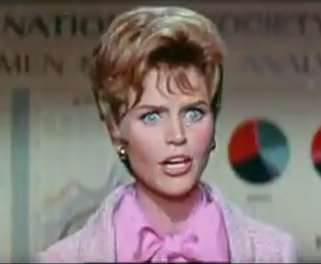 She also explains that even if she got married, she would hold off on having a baby because that would end her career. Wow--a different reality back in the '60s! (Yet, I can't help wondering how far we have come. Some hypothesize that motherhood still has a negative effect on career advancement.*)Molly can predict Henry's every move and successfully resists. Almost. In the end, her plans change. Molly is going to marry Henry and move back to Texas with him.
*See Sarah Hoye's (CNN), Jayita and Murali Poduval's (National Institute of Health), and Lisa Quast's (Forbes) articles for more info on this topic.
- The Thrill of It All (1964) - This week brings us two James Gardner movies (double sigh). During my first viewing, I thought, Oh I like this one--a light, fun movie with a working mother at its center. I still enjoy the movie. I can relate--as I imagine many working moms can--to that torn, guilty feeling of not always being there to for all the little moments in our children's lives. At the same time, I can understand why Beverley Boyle (Doris Day) enjoys her job. She is her own woman, able to contribute to the household fund for the first time. As an added bonus, she gets to communicate with other adults.
While she revels in her new spot on the financial food chain, her husband Gerald (James Gardner) becomes more and more irritated with her career. She is neglecting her duties on the home front such as having his dinner ready and saying good night to the children. The situation escalates until finally both decide it would be better for her to give up her career and solely be a mother and wife. She seems pretty pleased with the decision. In fact, the ending implies that she is going to have another baby. (Because babies solve all major conflicts at home, right?)
The last straw... Source
- Sex and the Single Girl (1964) - This movie chronicles the fictional version of Dr. Helen Brown (Natalie Wood), a psychologist who has written a book about being single and living like man; i.e. sex with whomever and whenever you wish, and the rat, Bob Weston (Tony Curtis) who is trying to secretly publish an article documenting what kind of woman she is. (Remember, the message goes that there are two kinds of women--those who do and those who don't.) Bob is not the only one who desires this knowledge. Helen's co-worker Dr. Rudy DeMeyer (Mel Ferrer) also indicates that he is dying to know her type and essentially tells her that he hopes their elegant evening together pays off. So if a guy provides a nice date, you have to put out? Wowzers--this is a message for further exploration! (Not to mention how he keeps coming on to her after she has clearly expressed disinterest in his advances... Sexual harassment in the office, anyone?) Helen is full of contradictions. She declares, "Married! I don't want to be married! I've got work I care about much more." Yet she believes that men have the "opportunity, challenge, and responsibility" to marry as this is the only thing that sets humanity apart from animals. By the end of the flick, Helen rocks a stuffed animal as though it was a baby and realizes, "I don't want to be a single girl!" She gives up her practice to marry Bob. The sentiment of the movie can be summed up in two quotes:

A tongue-and-cheek statement by Gretchen (Fran Jefferies), Bob's girlfriend (if you can call her that--she is more of a booty-call), "I wouldn't give up my career for marriage, kids, and happiness." True happiness lies in marriage for women.
Acted with mock enthusiasm, Bob announces to a co-worker, "You may have power, money, and sex. But I've got love!" Bob's declaration is part of a joke. Love is not what men want. Marriage is a trap. Just ask his neighbor, Frank Broderick (Henry Fonda), who regularly dodges objects thrown at him by his ever jealous wife Sylvia (Lauren Bacall).
And with that, the series on Career Girls and Marriage is concluded--for now. Thank you for reading! Please feel free to comment or email me with titles of movies that deal with career and marriage. I would love to explore this topic further and welcome anomalies to the standard Hollywood message.

