Showing posts with label Marriage. Show all posts

Saturday, July 25, 2015

I Do and I Don't: A History of Marriage in the Movies

ISBN 978-0-307-26916-4
Jeanine Basinger's I Do and I Don't is clearly the work of extensive, passionate research. The film historian explains that marriage is rarely the main subject of films and certainly never advertised as such. In order to give the marriage movie a face, she viewed hundreds of films in search of plots where "the state of being married" was the sole focus (xvi). Basinger divided her findings into three sections: The Silent Era (20 pages), The Studio System (280+ pages), and The Modern Era (50+ pages). Each is peppered with photographs (on the back inside flap, the book boasts 139 illustrations), which give visual support to Basinger's assertions.

It is supreme irony that moviegoers could be conned into believing in romance that led to happy endings in one kind of movie, and then be shown that what came after the happily-ever-after was pretty awful...yet still be conned all over again into believing that the awfulness could be fixed, made new, and restored to the point of the original happy ending. (Basinger 3)
Arbuckle & Normand, comedic marriage movie team
From a cinematic standpoint, marriage must be plagued with problems because conflict is fundamental to good storytelling. If there is no conflict in the marriage, there is no story to tell. Basinger examines how Hollywood packaged these marital problems. During the silent era, filmmakers presented marriage and its problems in two extremes: either “raucous comedy or stark tragedy” (7). Assuming viewers were married and miserable, the comedy invited them to laugh at their joint misery. On the other hand, the drama told a cautionary tale upholding societal values, but not before letting the audience view plenty of sin and, as Basinger puts it, “Participate without consequences” (16). The films also allowed their viewers to escape to an exotic location and vicariously share in a luxurious lifestyle with grand bathrooms, furniture, and clothes. The historian notes these last elements can still be seen in today’s films with their large homes and elaborate kitchens.

In the next section, Basinger describes a shift from the exaggerated to the more familiar under the studio system. She details all aspects of the studio system formula—the purpose, patterns, couples, problems, and situations—making the book an ideal read for students of film studies. Movies made during this period reassured married viewers that all ends well for those who stick with it through hard times. According to Basinger, two patterns emerged: the “I Do” pattern of affirm-question-reaffirm-resolve and the “I Don’t” divorce pattern (told in flashback) of question-affirm-resolve-reaffirm. The latter movie discussed divorce, but the event never actually occurred due to the Production Code, hence the reaffirm portion of the pattern. Basinger also covers variations of the marriage movie: “without love” and “oops, we’re not married!” marriages. In these films, tension is built because the chase continues despite the couple being married.

Basinger identifies seven recurring problems in the studio system marriage movie: money, infidelity and/or adultery, in-laws and children, incompatibility, social class, addiction, and murder. She cites numerous examples of each type of problem, noting that most movies have a combination of forces at work. In case some might think the issues are strictly American, Basinger also delves into foreign films demonstrating that “marriage films transcend cultural differences. […] Croissants, smorgasbords, or green tea, marriage is just marriage” (252).

Before moving into the final portion of her book, Basinger looks at the one external problem that can overrule the other seven: “when a movie married couple faced a large, historical situation outside their control, such as the war (and later the Sexual Revolution), their problems were subjugated to the situation” (254). This part of the book would be especially appealing to anyone who enjoys learning about World War II as Basigner spends much time analyzing WWII films. Through research of memoirs, newspaper and magazine articles, she verifies the authenticity of the events portrayed in such films, finding the circumstances on the home front not far from what was projected onscreen. To further prove her point that the situation "trumps" all other problems, she shows that the absence of war (the situation) results in the return of the seven prewar problems in films. 

The final section encompasses movies from the 1960s forward. While the section appears small, it is important to note that Basinger incorporates modern movie examples throughout the book whenever appropriate. With social change, marriage was no longer an expected state of the human experience. Women, the primary target of the marriage movie, were not interested in the institution. The genre declined as filmmakers avoided the financially unsound subject. When a marriage movie was made, the characters often debated or discussed the institution--an ongoing trend which Basinger coins "the therapy session." There are movies, however, that continue to follow the old formulas. Analyzing one of the examples, Mr. and Mrs. Smith (2005), Basinger observes, "As is always the case, marriage is destroyed and restored, shown to be unworkable, and then worked out" (343). On the flip side, the author takes note of an emerging theme in current movies, one in which there is "no resolution, no closure, no reassurance, and finally, no explanation" (358). She predicts that this will be the future of the marriage movie.

~ ~ ~

Basinger's book is conversational in tone. As such, there are quick asides throughout, often humorous in nature. For example, regarding the perfect "older" husband during the studio system: 
He was rich, he gave you everything, he solved all your problems--and then he died and got out of your way so you could marry a really hot guy. (115 in footnote) 
Describing the plot of The Egg and I:
They set out in his car, and as they drive farther and farther up into the thickly wooded hills on their way to their new home, the goat they are bringing with them eats her new hat. (Every woman in the audience immediately knows that this hat thing is a terrible omen.) (124)
These comments do not take away from the book as she does not veer off the path for long. In fact her quips are often located in parentheses or footnotes. If the reader prefers a more straightforward read, the comments can be avoided altogether. However, in my opinion, they add flavor, a personal touch to her book.

On her quest to document the history of marriage in movies, Basinger describes hundreds of films from the silents to modern day. Everyone who reads her book should walk away with a few new films to view. (As I write, I have two films waiting on my DVR--one new and one I wish to revisit after reading her take on it.) Basinger also includes a brief analysis of TV marriage sitcoms in her book, so readers might come away with a new sitcom to check out as well.

~ ~ ~

In addition to reading I Do and I Don't, individuals may be able to take a free course on the subject from Basinger via Coursera (the class has been offered the past two years, no information on when it will be offered in the future). Those who have taken the course will most likely be bored by the book as much of the lecture follows the text word for word. If you read the book first, the bonus of taking the course would be the opportunity to hear and see Basinger (lectures are prerecorded), view clips of a few movies she describes in the book, and discuss the films with other students who are taking the course. The course is not graded, so it is a low pressure environment.
Work Cited

Basinger, Jeanine. I Do and I Don't: A History of Marriage in the Movies. New York: Alfred A. Knoff, 2012. Print. 

This review is part of the 2015 -

Hosted by Raquel at Out of the Past Blog

Friday, April 3, 2015

A Marriage of Convenience

This is part of the 2015 Pre-Code Blogathon hosted by Danny at Pre-code.com and Karen at Shadows and Satin. Read more fantastic posts by clicking here.

The acting is rough, the sound and lighting need work, but for anyone who has ever been thrown over for someone new, Consolation Marriage (1931) is just what the doctor ordered. The film has not one, but two thwarted lovers looking for someone with whom to drown their sorrows.


The movie opens on an overjoyed Steve Porter (Pat O'Brien) en route to marry his long time sweetheart Elaine (Myrna Loy). He arrives at Elaine's abode only to have her inform him, rather unaffectedly, that she was married the Tuesday prior. Steve is sunk and does what many a brokenhearted soul would do: he gets good and drunk and stays that way--at least until he meets Mary (Irene Dunne). But more on their meeting in a moment...

Like Steve, Mary has been jilted by her amour. Aubrey (Lester Vail) is a struggling pianist who has decided to advance his career through marriage to a wealthy Mrs. (the film does not indicate if the woman is widowed or divorced). Mary is the stereotypical good sport. Without tears or fight, she allows Aubrey to profess his love to her though his bride-to-be waits in the car below. Instead, Mary chooses to say "good-bye with a smile." 

Later that evening, Steve introduces himself to Mary in a bar. There is some talk regarding whether or not the unchaperoned Mary is a "nice" girl (virgin/whore dichotomy surfacing), which in a roundabout way brings the characters to the realization that they are in the same boat love-wise. (She explains that she is without a chaperone because he [Aubrey] is getting married to another.) Mary comments that she is ready for her entitled good cry, and Steve offers to join her.

 Clip via TCM.com.

Misery loves company, and no one can commiserate like another person fresh off a breakup. It is no surprise then when Steve and Mary begin spending time together, discussing how their former flames understood them like none other. In lighter moments, they banter back and forth naturally, laughing and enjoying each other's company. On one of their outings, Steve and Mary adopt a dog. This leads to an impromptu proposal from Steve, who wants the pup to have a proper home. And here is where the pre-code shines through the script:

Steve suggests that their marriage be one of no obligations. If it doesn't turn out, they simply leave with a "good-bye and good luck"--no questions asked. Mary likes the idea and agrees. They even liken marriage to a football game. No harm, no foul. An incredibly radical idea for the day, and I would venture to say that it still is. Despite the high divorce rate (or perhaps as evidenced by it because we are too quick to fall in the first place) in the USA, we tend to marry with the intent of staying married.

The film wastes no time showing that Steve and Mary's marriage is indeed one of convenience and not flaming passion. Tokens of their ex-loves remain present in their home: Aubrey's wedding gift of a cupid clock and Elaine's hearts-and-flowers handkerchief. Even so, Steve and Mary's union produces a child, which means they were, ya know, doing it even though they weren't in love. This is another clear mark of pre-code movie making.

Elaine comes back into the picture. In a note to Steve, she explains that her marriage has failed (surprise!), and she is getting a divorce. Mary has caught on, and though she puts on a brave front, we can tell (via Irene's facial expression, no words necessary) she is worried about losing her husband. A similar note arrives from Aubrey, and Mary jumps at the "chance at happiness." As Mary prepares to leave Steve and their daughter, she reasons with the baby, explaining that "a baby is only an episode in a woman's life," and she would think her mother foolish if she gave up the chance for happiness because of traditional values. Suitcase in tow, Mary ends up at Aubrey's apartment.

*** Spoilers Ahead ***

Up to now, Mary has touted a carefree attitude, and for beat, it looks as though the unconventional marriage will reign supreme. However, it doesn't take Mary long to realize that she has changed. Life does that. Aubrey and his tunes are no longer enough.  "My baby needs me," she explains to her befuddled ex-beau, "Or I need my baby. I don't know which." Mary rushes home. She has forever closed the door on her past love, knowing full well that Steve may not do the same when he gets his turn.

Mary doesn't have to wait long for this to happen. On Steve's invitation, Elaine shows up on her doorstep that evening.  She stands poised and confident, the perfect homewrecker played by the woman who would later be typecasted as the perfect wife. Although Loy got her start in roles as the other woman, I'll admit it was kind of weird seeing the future Mrs. Charles swoop in to steal another character's husband. In true martyr fashion, Mary prepares Elaine for Steve, going so far as to powder Elaine's back and fix her hair.

Elaine goes to Steve, and he takes her into the garden. While she talks of moonlight, Steve relates what he and Mary have been planning to do with the yard. To Elaine, love still exists in the abstract--the beauty of the night, the bursting of bubbles. Steve, on the other hand, has moved beyond their childhood poetry and into the concrete. Love is an action not an abstract noun. He excuses himself from Elaine and returns to Mary who has been crying in their daughter's room.

In the end, Mary and Steve discover they have misplaced their romantic yearning and are in fact in love with each other. While the ending seems traditional, it is pre-code (im)morality that permits their enlightenment. The fruit is never forbidden, so each reaches awareness in their own time. Fortunately for them, they have similar timing. Magic of Hollywood. Not sure that would work in real life.

Nonetheless...there is something I love about this movie. Maybe it's the friends to lovers formula. (I'm a sucker for When Harry Met Sally.) Or it could be the more mature viewpoint that true love is not always found in fireworks, but silently blossoms over time, in the everyday ordinary. Either way, Consolation Marriage has become a guilty pleasure. 

Now if only the film would be digitally remastered on DVD...

Currently Consolation Marriage is only available on VHS.

Tuesday, January 6, 2015

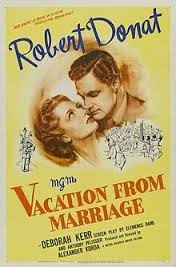
Vacation from Marriage (1945)

***This is an exception to my no play-by-play rule. Warning: spoilers abound.***

Posted prominently on the fabric bulletin board above my desk is the phrase: "Never be afraid to try something new." It serves as a reminder to always seek adventure and new opportunities. In terms of marriage, it evokes images of Nick and Nora Charles as they go wherever the leads take them with cocktails in hand and a quick quip to lighten any misstep. In their eyes, the risk of adventure is worth the humor and affection it brings. And along the way, they catch a crook or two.

 The antithesis of Nick and Nora would be Cathy (Deborah Kerr) and Robert Wilson (Robert Donat) in Vacation from Marriage (1945; known as Perfect Strangers in Britain). The couple's life is an unending dance of drudgery:
Cathy - Opens window. Sneezes. Passes shirt collar through the door. No word spoken. Picks up newspaper from doorstep. Places on table. 
Robert - Comes out of bedroom. Changes date on calendar. Adjusts the time on the mantle clock. 
At breakfast table - Lifelessly stare at each other. No word spoken.

Reality of marriage. No glamor girls or Hollywood hunks here, folks. 

Thursday, November 6, 2014

'60s Career Girls and Marriage

And now it is time to wrap up my Career Girls and Marriage series (although the more I watch, the more I want to add--I may need to revisit in the future). 

Onto the 60s, a tumultuous time of conflicting identities:
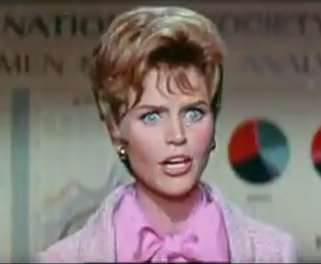
  • Wheeler Dealers (1963) - In this film, career women are presented as two types: the ones who work in order to find a husband and those who work because they find fulfillment in their job. Molly Thatcher (Lee Remick) is one of the latter while her roommate Eloise (Patricia Crowley) is of the former, working uptown where it is easier to bag a husband. Molly, on the other hand, works downtown where a girl has to be "twice as smart to get half as far." Interesting observation of the glass ceiling. Molly wants to be a respected business woman, but her working environment is less than conducive to her desires. Although she is unaware of it, her bosses are trying to fire her with the rationalization that hiring a female employee was just an "experiment" anyways.
    She belongs to a lunch club, which is full of women who want to move up in the world, yet is managed by men. Apparently the men have not received the memo as they prefer to discuss facts about bobby pins and kitchen appliances as opposed to the facts and figures of Wall Street.
    Molly challenges the club's male speaker; she is insulted that women are not being taking seriously in the work world and are considered emotional and "excitable." What a rally cry! The irony, however, is that the women are portrayed as emotional and excitable at the very time she is delivering her message. One step forward, two steps back. To top things off, Molly is relentlessly pursued by the rather handsome Henry Tyroon  (James Gardner...sigh...) who has plans to make her his girl. Along the course of the way, she informs him (and us) that she prefers to be admired for her intelligence, not her beauty.
    She also explains that even if she got married, she would hold off on having a baby because that would end her career. Wow--a different reality back in the '60s! (Yet, I can't help wondering how far we have come. Some hypothesize that motherhood still has a negative effect on career advancement.*)
    Molly can predict Henry's every move and successfully resists. Almost. In the end, her plans change. Molly is going to marry Henry and move back to Texas with him.
*See Sarah Hoye's (CNN), Jayita and Murali Poduval's (National Institute of Health), and Lisa Quast's (Forbes) articles for more info on this topic.

  • The Thrill of It All (1964) - This week brings us two James Gardner movies (double sigh). During my first viewing, I thought, Oh I like this one--a light, fun movie with a working mother at its center. I still enjoy the movie. I can relate--as I imagine many working moms can--to that torn, guilty feeling of not always being there to for all the little moments in our children's lives. At the same time, I can understand why Beverley Boyle (Doris Day) enjoys her job. She is her own woman, able to contribute to the household fund for the first time. As an added bonus, she gets to communicate with other adults.
    The last straw... Source
    While she revels in her new spot on the financial food chain, her husband Gerald (James Gardner) becomes more and more irritated with her career. She is neglecting her duties on the home front such as having his dinner ready and saying good night to the children. The situation escalates until finally both decide it would be better for her to give up her career and solely be a mother and wife. She seems pretty pleased with the decision. In fact, the ending implies that she is going to have another baby. (Because babies solve all major conflicts at home, right?)  
  • Sex and the Single Girl  (1964) - This movie chronicles the fictional version of Dr. Helen Brown (Natalie Wood), a psychologist who has written a book about being single and living like man; i.e. sex with whomever and whenever you wish, and the rat, Bob Weston (Tony Curtis) who is trying to secretly publish an article documenting what kind of woman she is. (Remember, the message goes that there are two kinds of women--those who do and those who don't.) Bob is not the only one who desires this knowledge. Helen's co-worker Dr. Rudy DeMeyer (Mel Ferrer) also indicates that he is dying to know her type and essentially tells her that he hopes their elegant evening together pays off. So if a guy provides a nice date, you have to put out? Wowzers--this is a message for further exploration! (Not to mention how he keeps coming on to her after she has clearly expressed disinterest in his advances... Sexual harassment in the office, anyone?) Helen is full of contradictions.
    She declares, "Married! I don't want to be married! I've got work I care about much more." Yet she believes that
    men have the "opportunity, challenge, and responsibility" to marry as this is the only thing that sets humanity apart from animals. By the end of the flick, Helen rocks a stuffed animal as though it was a baby and realizes, "I don't want to be a single girl!" She gives up her practice to marry Bob. The sentiment of the movie can be summed up in two quotes: 
    A tongue-and-cheek statement by Gretchen (Fran Jefferies), Bob's girlfriend (if you can call her that--she is more of a booty-call), "I wouldn't give up my career for marriage, kids, and happiness." True happiness lies in marriage for women. 
    Acted with mock enthusiasm, Bob announces to a co-worker, "You may have power, money, and sex. But I've got love!" Bob's declaration is part of a joke. Love is not what men want. Marriage is a trap. Just ask his neighbor, Frank Broderick (Henry Fonda), who regularly dodges objects thrown at him by his ever jealous wife Sylvia (Lauren Bacall).

And with that, the series on Career Girls and Marriage is concluded--for now. Thank you for reading! Please feel free to comment or email me with titles of movies that deal with career and marriage. I would love to explore this topic further and welcome anomalies to the standard Hollywood message.

Friday, October 17, 2014

The Paradox of Career, Marriage, & 1950s Movies


After my last post, I came across some interesting tidbits about working women in the 1950s. The info was too good to let pass, especially since we just explored career women in 1950s movies. According to two books I have been jumping between, married working women were more prevalent in the 1950s than in prior decades. Adrienne McLean in Being Rita Hayworth explains that "between 1950 and 1960 more than four million married women took jobs, accounting for 60 percent of all new workers" (17). In "Old Soldiers Never Die: Father's Little Dividend and the Fading Patriarch," Kristen Hatch provides a more specific detail: "In 1951 a third of American women of working age were in the labor force, and the majority of them were married" (46).

What?! I thought. The evidence I found in the movies said otherwise. The message seemed to say that a woman can find true happiness only in marriage, family, and a home.

So I checked the U.S Bureau of Labor Statistics (BLS). Sure enough, Hatch's statement regarding the number of working woman was accurate. Per "Labor Force Change, 1950-2050," an article in a BLS journal, "In 1950, the overall participation rate of women was 34 percent" (Toossi 18). This does not, however, indicate how many of the women were married. I continued digging. Another BLS article, "Family Labor Force Statistics" points out that "In 1950, participation rates of wives were much the same as they had been in 1944" (Waldman 17). Contrary to common belief, women did not leave their wartime jobs and crawl back into domesticity.

So why the paradox between movies and reality?

Some might say 34-percent is not a particularly large number, so there is not really a discrepancy. While this may seem like a small amount by today's numbers, I'm sure this seemed like a large percentage at the time. Another thought is that our current understanding of the 1950s woman is derived from Betty Friedan's The Feminine Mystique which is "flawed by its reliance on a handful of conservative writings" (McLean 16). Since I am not familiar with the "conservative writings" in question, I am not comfortable drawing a conclusion based on this theory.

Another possibility for the paradox lies in the very nature of movies. They are fantasies, often the ideal version of ourselves. Hatch hits upon this in her essay: "Our misconception that this was a time of stability with regard to gender and family life is largely due to the popular domestic comedies of the period, which created a fantasy of the typical American family" (Hatch 46).
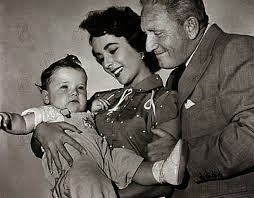
Elizabeth Taylor and Spencer Tracy
She further suggests films such as Father's Little Dividend (1951) attempted to preserve an old way of life that was slipping away as women became more financially independent. Whether or not the fantasy was created "to preserve the notion that the typical family is headed by a [male] breadwinner" (49) or the idea that a woman's place is in the home, what remains is a past painted a shade lighter than reality. I am reminded that history is written by the victors and the past is what we create it to be, not necessarily what it actually was. Or in this case, what the filmmakers of the 1950s created it to be. 

Works Cited

Hatch, Kristen. "Old Soldiers Never Die: Father's Little Dividend and the Fading 
      Patriarch." American Cinema of the 1950s: Themes and Variations. Ed. 
      Murray Pomerance. Piscataway, NJ: Rutgers University Press, 2005. 46-49. 
      Print.

McLean, Adrienne. Being Rita Hayworth: Labor, Identity, and Hollywood 
     Stardom. Piscataway, NJ: Rutgers University Press, 2004. Print.

Toossi, Mitra. "A century of change: the U.S. labor force, 1950-2050."  
      Monthly Labor Review May 2002: 15-28. Web. 13 Oct. 2014. 

Waldman, Elizabeth. "Labor force statistics from a family perspective."  
      Monthly Labor Review Dec. 1983: 16-20. Web. 13 Oct. 2014.

Monday, October 6, 2014

'50s Career Girls and Marriage

Not so easy to find is the 1950s career girl. But with a little research, I not only came across a great new book series that I can't wait to sink my teeth into, but also found an awesome example of a '50s career gal. It's an old favorite with a message I missed until I read Sumiko Higashi's essay in American Cinema of the 1950s: Themes and Variations. 
 
Froman's career & marriage don't mix.
  • With a Song in My Heart (1952) - This musical biopic chronicles singer Jane Froman's (Susan Hayward) rise to stardom, troubled marriage, and debilitating injury. Author Sumiko Higashi points out that the movie is careful to portray her success as being spurred forward by her husband as opposed to her own ambitions as a career woman. She laments that "she wants 'a real home'" and pities her husband because "'it isn't easy for any man being married to a woman in the spotlight'" (78). She further declares, "If [her career is] going to spoil our marriage, it just isn't worth it'" (78). After she is injured, it is the medical bills--again not her ambition--that prompt her to go back to her singing career. The message is clear: married career women work as a result of external circumstances not internal desire.
Memory triggered, I was able to come up with another 1950s movie with a career gal:
Poor Fred is taken for granted...
  • There's Always Tomorrow (1956) - Norma Miller Vale (Barbara Stanwyck) is a successful fashion designer. She meets up with a former co-worker, Cliff Groves (Fred MacMurray), who is married and has three teenage children. His marriage is in a bit of a rut, making the single and fancy free Norma very attractive. Cliff's wife Marion (Joan Bennett) is not concerned. Marion feels secure in her position, suspecting that Norma most likely envies her domestic life. Sure enough, nothing much comes from Cliff and Norma's brief dalliance, other than Norma's realization that her life is empty without a home, marriage, and children--just as Marion and we could have predicted. 

Join me next week as I complete the Career Girls and Marriage series with an analysis of '60s career girls in films.

Works Cited

Higashi, Sumiko. "With a Song in My Heart: Can This Star's Marriage Be Saved?"
         American Cinema of the 1950s: Themes and Variations. Ed. Murray 
        Pomerance. Piscataway, NJ: Rutgers University Press, 2005. 77-81. Print.


Monday, September 29, 2014

'40s Career Girls and Marriage

The 1940s were a unique time for the career girl. From 1942 to 1945, the boys were away at war which left a large gap in the workforce. Campaign posters, such as the one that came to be associated with Rosie the Riveter, encouraged women to take men's vacant spots. Whether or not this caused a switch in career girls and marriage on film is difficult to say. The first movie on my list was released prior to the war while the final film made its debut at the end of the decade. In any case, viewing a married career girl on screen would not have been as big of an anomaly as the decade prior. Although much more subtle, the message that career girls and marriage don't mix continued to be sprinkled throughout the '40s with some revolutionary gems popping up here and there.
 
  • His Girl Friday (1940) - The decade kicks off with this wonderful exception to the career versus marriage rule. Typically, the woman forgoes a career for marriage. In this movie, quite the opposite occurs. Hilda Johnson (Rosalind Russell) attempts to give up her career as a newspaper reporter to marry the stable--and boring--Bruce Baldwin (Ralph Bellamy). However hard she tries, though, she cannot resist the thrill of chasing a good story. In the end, her career wins, and she skips marrying Bruce in favor of Walter Burns (Cary Grant), who would prefer his star reporter to retain that status. Their marriage will not interfere with breaking news stories. An interesting side note: Hildy was originally supposed to be a man. Howard Hawks changed the character's gender after his secretary read the lines, and he liked the way dialogue sounded (TCMDb). This unique union of career and marriage was accidental.
  • Woman of the Year (1942) - Rival reporters Tess Harding (Katharine Hepburn) and Sam Craig (Spencer Tracy) fall in love and marry. Neither give up their career, and it isn't long before Sam feels neglected. Like last week's Ann Carver's Profession (1933), the wife is to blame. When Tess adopts a little refugee boy, Sam objects, explaining that they don't have "the kind of home he'd be happy in" quickly followed by the more direct jab, "Now if you could just spare about ten-percent of [your] heart from the world at large and apply it at home..." Tess may be named "Woman of the Year," but in his eyes she is not living up to the task. He tells her as much on the night of her awards banquet, which she is more concerned about attending than finding someone to stay with the boy. Before she leaves, he comments, "The Outstanding Woman of the Year isn't a woman at all." Ouch!
    Later her aunt Ellen, also a career woman, gets ready to tie the knot and shares with Tess that she would rather be "the prize" than continue to win prizes. That does it. Tess decides to change, to try to become a traditional wife.
    Unlike Ann Carver, there is no melodramatic final scene--this is a comedy after all. Tess fails miserably in her domestic endeavors. Her waffles overflow, her toast pops over zealously, and her coffee bubbles over. Sam decides to meet her halfway. He'll accept her as long his last name makes the title: Tess Harding Craig. The final gesture of "launching" her PR guy informs the audience that he wears the pants in the family now. Tradition has (somewhat) prevailed.
  • Mildred Pierce (1945) - I would be remiss if I did not mention this well known celluloid career woman. Unlike the other ladies in this category, Mildred Pierce (Joan Crawford) works in order to provide for her daughter Veda's (Ann Blyth) every whim. At one point, she even marries so her daughter has the social connections she (Veda) so desires. The movie is more a portrait of a self-sacrificing mother than a career girl who loves the work she does. Once Veda no longer needs her mother; i.e., goes to the big house, Mildred reunites with her first husband, and there is a sense that she will not be returning to the business world.

  • June Bride (1948) - When Linda Gilman (Bette Davis) crosses paths with her ex-beau Carey Jackson (Robert Montgomery), she tells him to forget she's a woman. She is now a career focused woman and wants no part in love. After all, he walked out on her three years prior. The message: a career woman is a bitter, scorned woman. How to cure it? (Because, the message reads, careers must be cured out of women.) True love, of course. The result is an enjoyable film filled with witty banter as Carey chases Linda, trying desperately to win her back. In the final minutes of the film, Linda has (surprise!) a change of heart and is determined to get Carey back. Up to this point, she has remained true to her career even while tinkering with love during moonlit moments. But then she offers to not only follow him wherever his stories take him, but also to do no more than carry his bags behind him. Somehow I can't image Bette Davis or her successful magazine editor character stooping so low. Message delivered nonetheless.
  • Adam's Rib (1949) - Amanda (Katharine Hepburn) and Adam Bonner (Spencer Tracy) are wife and husband lawyers who are able to have both successful careers and a successful marriage. The film chronicles a difficult time in their relationship as they take on opposing sides of a court cases. They push through with some laughs and lots of love (including one very memorable love pat, which brought to light the issue of whether or not it is okay for a husband to hit his wife even in jest) to demonstrate that a career girl can have a successful marriage. 

Going through the list of films this week, there are a few examples of women who were able to have successful careers and be happily married. Hildy (we assume), Tess, and Amanda. (Shout out for Rosalind Russell's and Katharine Hepburn's strong women roles!) Being a mother--and a working one at that, I couldn't help but notice something, er, someone missing from the equation: children. I wonder, would all have ended well if these women had a brood to raise at home? Or would we see a shift in the message--career and marriage can occur from time to time, but never with children? Another message worth exploring later down the road.

Join me next week as I continue to explore Career Girls and Marriage during the 1950s.

Monday, September 22, 2014

'30s Career Girls and Marriage

Sometimes the occasional rogue woman will try to "live like a man," finding contentment in her career. This week I examine what happens in a pair of films from the 1930s.

  • Female (1933) - What a dazzling display of girl power! Alison Drake (Ruth Chatterton) is the CEO of a large company and runs it with finesse and efficiency. She also treats men as they so often treat women. One by one, she invites her male employees home to "talk business." She sets the mood with music and Vodka and has her fun with them. The following morning, she dismisses them at the office. When they become "jealous, moody men," she transfers them out of state. Her career is her life, and she loves it.
    Chatterton in Female - LOVE this powerful dress!
    She meets her match in Jim Throne (George Brent), who is not so easily seduced. He chides her for thinking she's above "love and children, the things women were born for" (ah yes, the every girl should marry message in the movies). Alison is converted. She misses an important meeting to fetch her man and let him know she is his. Girl power? In the end she gives it all up, a gift to the man she wants to marry. Jim will run the business, and she'll run the home--complete with nine children. Now, I'm not advocating women use and abuse men, but the movie's ending was a bit of a let down. So much for the image of a powerful woman... 
  • Ann Carver's Profession (1933) - Here is another woman who loves her career. Ann Carver (Fay Wray) is "aching to go to work" instead of hanging around the home all day. Her husband Bill (Gene Raymond) approves until she gets a $5000 bonus for a court win compared to his measly $10 raise. Bill's delicate male ego is further bruised when he gets no love from his workaholic wife while she entertains business associates. (Hmmm....interesting double standard here. If it was he who entertained, would she be allowed a complaint? I think not.) Ann tries to smooth things over with her unhappy hubby. And behold--a pleasant surprise--she actually admits that she would be lying if she said she wanted to give up her career. Poor guy (ha!) feels forced to take a job as a crooner to make more money and give up his architect job in the process. It is her boss's (Claude Gillingwater) turn to dole out the advice, "a man can't stand the burden of obligation. Especially to a wife." (Good golly--really?!)
    Long story short, Bill becomes linked to a murder, and his wife must come to the rescue. In her final plea to the jury she blames herself for her husband falling into bad company. She believes she deserves the jury's "contempt" rather than her husband "for her blindness and stupidity." She explains she was like a "machine" with her work and "drove him out." She asks the jury to "pity any woman who has the most precious thing in life and blindly sacrificed it." She announces that the conclusion of the case will also be the end of her career as it has brought her "nothing but heartache and despair." Bill is found not guilty, she gives up her career, and they live happily ever after. Message? Career girls and marriage don't mix.
Join me next week as I continue to explore Career Girls and Marriage during the 1940s.

Monday, September 15, 2014

Every Girl Should Be Married

Sinatra & Reynolds
For better or worse, movies have been telling us that matrimonial bliss is the key to true happiness. More specifically, it--along with children--are the only way for a woman to be truly fulfilled. Men, on the other hand, might be content to live out their bachelor lives, finding satisfaction in their careers and multiple visitors in their beds. Therefore, the message goes, it is up to the woman to resort to trickery to help her chosen mate realize domestic bliss. A few examples through the decades:

  • Double Harness (1933) - Joan (Ann Harding), who is on verge of spinsterhood, declares, "Marriage is a woman's business," and goes about getting herself hitched. She arranges for her father to catch her with her boyfriend (William Powell) in a compromising situation, resulting in their "forced" marriage. Both find happiness when they discover they are also in love with each other. 

  • Every Girl Should Be Married (1948) - When Anabel (Betsy Drake) sets her sights on Madison (Cary Grant), an unmarried doctor, she does not have the pre-code convenience of being found in a negligee in Madison's apartment. No worries--she has many other tricks up her sleeve, including inciting all the women attending one of Madison's lectures to admit they used trickery to trap their husbands. Speaking of which... 

  • The Tender Trap (1955) - At this point in cinematic history, husband-trapping is a fact of life, so why not make a humorous romp of it? Like Powell's and Grant's characters, Charlie (Frank Sinatra) is a confirmed bachelor and there is a woman, Julie (Debbie Reynolds), with designs to snare him. Julie's plan doesn't succeed in the short run, but by the end of the movie--and a quick lapse of a year--Charlie proposes to her. All is well that ends well.

  • Sunday in New York (1963) - Eileen (Jane Fonda) goes to her brother (Cliff Robertson) to find out "what the right procedure is in snaring a suitable man for the laudable purpose of making a home together and life with children and church-going and growing old together as is mentioned in both testaments and many other highly respected sources." Translation: she needs help attaining that highest womanly goal--holy matrimony. Unlike Joan of the early 30s, she is not willing to put out to get a proposal. And unfortunately the ploys of Anabel and Julie have not worked either. The trap is in question not whether to trap. Because what else would a single twenty-two year old American gal do?  

In 2003, the whimsical Down With Love paid homage to this favorite movie plot of yesteryear, that of the great lengths women go in order to snag a husband. At the same time, it is poking fun too. *spoiler alert* 
We find out the events that have unfolded throughout the movie are part of Barbara's (Renee Zellweger) elaborate scheme to entrap Catcher Block (Ewan McGregor). This updated version contends with another factor, though: her career, which is put on equal footing with--if not higher than--marriage. Well, almost... Come back next week for a look at Career Girls and Marriage.