Showing posts with label Images. Show all posts

Friday, November 14, 2014

Fools for Scandal

The real scandal may have nothing to do with them.
I love Carole Lombard, Paris, quick witty dialogue, and light fluffy comedies. When I saw Fools for Scandal (1938) come across my Facebook feed, promising all of the above, I thought I had a sure winner. DVR set to record. Unfortunately this movie fell flat. Very very flat. Old champagne flat. I'm usually much easier to please. (Yes, I see messages in movies, but that does not interfere with my enjoyment of the films.)

What went wrong? Maybe my expectations were too high. Maybe it was the lack of chemistry between Lombard and her co-star Fernand Gravet (or the fact I was expecting Robert Montgomery--I swear the pic looked just like him--and got Gravet). Then there was that awkward attempt mid-movie to become a musical although no characters had spontaneously burst into song up to nor following that point.

To stay on the sunny side of the street, I did find one interesting nugget in my viewing. For being made after strict enforcement of the Hays Code, the movie is rather suggestive regarding two of the female characters in the cast: Lady Paula Malverton (Isabel Jeans) and Jill (Marcia Ralston). In hindsight, the foreshadowing is present before the camera first presents the ladies together. The main characters, Kay (Lombard) and Rene (Gravet), walk into the restaurant where Lady Paula is giving a party, and this is the act on stage:


Notice the woman dressed in traditional male attire 
among the other women who are dressed in beaded gowns.


At first glance of the table, Jill appears to be a male character. Her hair is slicked back and her outfit is distinctly masculine in nature. Lady Paula discusses how she has taken Jill to Paris and is paying for her French lessons. 

Jill's style remains masculine throughout the picture. At Kay's masquerade party, she again can be mistaken for a man:


Lady Paula leads Jill to another room away from the party. 

Among the ladies in the spaghetti strapped and backless gowns, she is dressed in a short sleeve, buttoned up shirt, black vest, and long pants.

Lady Paula discusses Rene's finer points. 
Jill appears amused and Kay surprised.


After the party breaks up, the two women leave together. Lady Paula, however, wants to go back into the house to investigate Kay and Rene's true relationship.


Jill looks worried. Afraid to lose her friend to Rene perhaps? Maybe to Kay?

The next morning, the city is aflutter with gossip (thanks to Lady Paula) that Kay is living with a bachelor. The ladies gather to ply Kay with questions:


In walks Jill, her masculinity exaggerated by the fact that once more she is surrounded by the ultra-feminine gals.


The remainder of the movie focuses on the main characters, leaving Lady Paula and Jill to their devices off-screen, which honestly would have been more interesting. 

While I would not recommend watching Fools for Scandal for entertainment purposes, it would be an interesting view if only to see how Hollywood treated lesbianism under Breen's watchful eye.
 

Sunday, October 19, 2014

The Image of Rita Hayworth

It's mid-October, Hispanic Heritage Month, and the perfect time to take a quick break from my Career Girls and Marriage series to celebrate Rita Hayworth. She is the birthday girl of the month, born October 17, 1918 (see the getTV Rita Hayworth Blogathon hosted by Classic Movie Hub for a list of wonderful reviews devoted to Hayworth). She is also one of the first Hispanic actresses to make it big in Hollywood although her widespread popularity did not come until after her Hispanic heritage was washed away.


If you are interested in a detailed account of Rita's transformation, you should stop by Backlots and read Lara Gabrielle Fowler's Rita Hayworth and the Loss of Hispanic Identity. (It is a fabulous read!)  

I am fascinated by how Rita Hayworth's all-American, sexy image is engrained into our public consciousness. Maybe my experience is unique, but for a long time my understanding of Hayworth was limited to her on-screen image and commentaries about her sex appeal to American G.I.'s. In fact, the first time I heard someone (probably TCM's Robert Osborne) talk about Rita's Hispanic heritage, I did a double-take, thinking they were discussing Rita Moreno. I have a feeling I'm not alone. In Being Rita Hayworth, Adrienne McLean observes that while the Hollywood publicity machine promoted Rita's "Latin heritage" and "ability as a dancer," they also glorified "her good looks [...] the result of much manipulation" (39). A quick internet search will demonstrate the number of images the powers-to-be presented to reinforce Rita's new American-ness.  

In the minds of her adoring public, Rita Hayworth was the all-American pin-up girl whose pose in a sexy black-laced negligee motivated the boys overseas. 


   "the" pic from Life magazine, 1941

Strangely, the image did not alienate her female fans. Was it because anyone who kept the boys inspired was a-okay? Or was it because her musical comedies brought her down to earth? She evoked memories of a simpler time--albeit whitewashed--as she charmed James Cagney in the musical Strawberry Blonde (1941). She hoofed with Fred Astaire in You'll Never Get Rich (1941) and You Were Never Lovelier (1942) and with Gene Kelly in Cover Girl (1944). When the boys returned, they fell in love with her all over again as she played the title character in Gilda (1946).  

Can't wait to do a write up on this noir someday!

How does the saying go? Women wanted to be her and men wanted to be with her.   

So entrenched was her image, the public was aghast when she dyed her trademark fiery red hair to blonde for Orson Welles' Lady from Shanghai (1947). The film's box office failure was partially attributed to her physical transformation.  


Over a half-century later, Rita's sexy Americanized image remains in our memories, but thanks to a growing body of educated classic movie fans, her Hispanic heritage will never be lost. 

Works Cited

McLean, Adrienne. Being Rita Hayworth: Labor, Identity, and Hollywood
      Stardom. 
Piscataway, NJ: Rutgers University Press, 2004. Print.


This post is part of the “getTV Rita Hayworth Blogathon” hosted by Classic Movie Hub and running during the entire month of October. Please visit getTVschedule to see a full list of Rita Hayworth films airing on the channel this month, and please be sure to visit Classic Movie Hub for a full list of other Blogathon entries.

Monday, June 9, 2014

A Star by Any Other Hair Color...

The other day I caught Janie Gets Married, a cute post-war film starring one of my favorites, the lovely Joan Leslie. The plot wasn't anything special, and I probably won't go out of my way to watch it again, but it did get me thinking. The supporting cast included Dorothy Malone; however she was barely recognizable (to me, at least) due to her brunette 'do. One may remember she made a big impression in a bit part as the brunette bookstore clerk who flirts with Bogart's character in The Big Sleep. I certainly remember--love that movie--nevertheless I was expecting a blond Malone to show up in the Leslie movie, the same Dorothy Malone most of us envision when hearing her name. Don't get me wrong, she was a beautiful brunette. So when did she transform into a blonde? What was the motivation behind changing her hair color?


One reason might be that she spent years as a brunette and did not find much success until portraying the obsessed, self-destructive blonde in Written on the Wind. Her performance resulted an Academy Award for Best Supporting Actress. No wonder she kept her new platinum tresses! The case seems pretty cut and dry, but I can't help but wonder if there is something more at play here.

Dorothy Malone is not the only actress of note who began their career with a hair color other than the one by which they are now defined. Remember that definitive red head, Lucille Ball?


How about Paulette Goddard?


Eleanor Parker anyone?


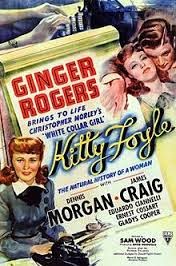
These women had star quality without the dye, so why change the color? As I contemplate the question, I find myself drawn to Kitty Foyle, the movie in which Ginger Rogers famously traded in her blond locks in favor of a darker shade.


Kitty Foyle is the story of a working-class girl who falls in love with an upper-class boy. They marry, but due to their different stations in life, the union is ultimately doomed and the marriage is annulled. In her autobiography, Ginger: My Story, Ginger Rogers writes, "After I had digested the script, I concluded that Kitty couldn't possibly be a blonde. She was the daughter of a proud Irishman, and had to look and act like one. Dark hair, blue eyes, a quick wit, and a stinging tongue" (269). 

Hmmm....could Ginger be alluding to a hair color stereotype that was present in Hollywood? Just as the white horse indicated the hero while the black signaled the villain, could hair color tell the movie goer what kind of woman was beneath the tresses?


Maybe actresses who wanted to change the type of roles they were being offered--or big studio bosses who wanted to fulfill a type that was lacking on the payroll--resorted to dye. Working woman? Brunette. Dizzy dame? Blonde. Good girl? Brunette. Obsessed, self-destructive floozy? Blonde. The implication of such typing is alarming when societal attitudes are at stake. (Could this be where blonde jokes originated? Think Marilyn Monroe and Jayne Mansfield.) 


It's a theory worth exploring.


Rogers, Ginger. Ginger: My Story. New York: HarperCollins, 1991.