Showing posts with label Disability. Show all posts

Thursday, June 30, 2016

April & May 2016 Viewing: Garland, Brunettes, and Secrets

How I feel by the end of May....
April and May are busy months in my neck of the woods. While my tweeps are gathering at the annual TCM Film Festival, I am readying students for state testing and our end of the year drama production. May sees me furiously grading papers to meet deadlines and calling or meeting with parents about kiddos who may not make it to the next grade unless assignments get turned in. For the most part, I am on island far away from Tinseltown and its movies, but even the hardest worker is entitled to a brief respite. Here are a few of the movies I caught.

Post covers: Pigskin Parade (1936), For Me and My Gal (1942), Little Nellie Kelly (1940), Presenting Lily Mars (1943), Till the Clouds Roll By (1946), Gentlemen Marry Brunettes (1955), The Secret Garden (1949)

Wednesday, July 15, 2015

Brunettes, Blondes, Disability, & Questions Out of the Past

I have long heard this film's praises which is why I added it to my 10 movies to see in 2015 list. Out of the Past (1947) turned out to be quite a treat. It almost seems morbid to say that with all the deaths in the movie, but you've got to appreciate a film that keeps you on your toes. 

I purposely avoided movie reviews and synopses so I could view the film with fresh eyes. I knew it was a noir and was fairly confident the brunette was going to double-cross the men. (I've watched The Maltese Falcon. I know to watch out for those sneaky brunettes...) Sure enough, the brunette is beautiful, but deadly. Her wardrobe is stunning and her role the juicier of the two female parts. 


The Brunette/Femme Fatale, Kathie Moffat (Jane Greer), in three of her gorgeous outfits

In contrast, the blonde, who plays little more than an audience surrogate (basic purpose: listen to the Mitchum character's past), is plain, but virtuous. She is the one we are to emulate. Go ahead and fall for the mysterious stranger, just don't marry him. 

The Blonde and not-so-glamorous Ann Miller (Virginia Huston)

The stranger in question is Jeff Bailey (Robert Mitchum), who fights the good fight, but in the end makes the noble sacrifice expected of characters who must atone for sins of a past life. In this case, Jeff gives up the [blonde] woman he loves. And the catalyst for the events? Whit Sterling, a wealthy gambler played by Kirk Douglas, making the leading three a cleft-chinned bunch: 

Robert Mitchum ~ Jane Greer ~ Kirk Douglas

The movie has the standard set of supporting characters: the gambler's tough sidekick (Joe - played by Paul Valentine), the detective's partner (Steve Brodie), the sly secretary (Rhonda Fleming).  

Dickie Moore - Source
In the mix is a character referred to as "The Kid" (Dickie Moore). "The Kid" is a minor role, reminiscent of Dick Tracy's loyal orphan pal of the same name (Dick Tracy, 1990). He doesn't get much screen time, but his inclusion is significant because he gives a positive representation of a person with a disability during a time when it was not common (arguably, still isn't). He is deaf without the stereotypical labeling or depiction. He is not a tragic figure to be pitied like Tiny Tim or fixed like Emily Blair in And Now Tomorrow (1944). Rather, "The Kid" is portrayed as capable and treated with respect by the other characters--even by the antagonists. At the same time, it is unlikely the writer, Daniel Mainwaring*, casually included a character with a disability.  Since "The Kid" is the first person the audience meets in connection to Jeff's new life, his young friend might be meant to tip us off that Jeff is a likeable guy despite his checkered past. In other words, "The Kid" may exemplify what Mariam Nathan Lerner describes as a "representation of deafness [...] to provide a window into audience understanding and appreciation of the protagonist."

*Mainwaring used the pseudonym Geoffrey Holmes when he wrote Build My Gallows High, the novel on which Out of the Past is based. 

The lines--writing and delivery of--are solid. I love the insight into Jeff's character from this exchange -
Taxi Driver: Buddy, you look like you're in trouble.
Jeff: Why?
Taxi Driver: Because you don't act like it.
Mitchum's character doesn't wear his heart on his sleeve. Another favorite -
Secretary: For a man who appears to be clever, you can certainly act like an idiot.
Jeff: That's one way to be clever. (Slight pause) To look like an idiot.
I've heard similar responses from Marilyn Monroe's and Ginger Roger's characters. It's interesting to hear it from a man. 

***Spoilers Ahead***
 
The twists compel the viewer to pay attention or lose track of who is crossing whom. After seeing it once, I feel there are parts that I missed. For example, when Ann's father reads the paper, he says that Jeff is wanted for two murders. I know about Eels. Who is the other victim? And what about the Kathie and Joe angle? Was she playing him like the other men? Or was he focused on not disappointing Whit or saving his neck? Is Whit and Joe's relationship more than platonic (Joe worried about disappointing Whit, Whit's extreme distress and anger at Joe's death)? Finally, Kathie had a remarkably accurate shot, why/how did she miss Whit at the beginning of the story--was there more going on?

These questions aside, the resolution was satisfying. I loved the irony of Kathie's last outfit. As she fully reveals how evil she is, her outfit gives her the appearance of a nun.

 
When Jeff tries to reason with her (like you can with this dame) that if they run off to Mexico, the police will find them, she responds:
I don't care. Just so they find us together.
Dang, I thought, She's ready to go out Bonnie-and-Clyde-style! I didn't know how close I had hit it.


Sources

Lerner, Mariam Nathan. "Narrative Function of Deafness and Deaf Characters in Film." Media/Culture Journal 13:2 (2010). Web. 15 July 2015. 

Williams, Tony. "Movies and the 'Enemy' Within." American Cinema of the 1940s: Themes and Variations. Ed. Wheeler Winston Dixon. New Brunswick, NJ: Rutgers University Press, 2006. 182-199. Print.  

Tuesday, July 22, 2014

Paging Dr. Gillespie - Disability in the Movies

When it comes to dissecting messages in movies, I must say that the disability experience holds a special place in my heart because my masters thesis focused on this lens of literary analysis. The disability experience has been neglected over the years. Much has been written regarding how women have been portrayed, how people of different races have been portrayed, how people who are homosexual are portrayed, and so forth. On the other hand, the disability studies field is relatively new and lacking in number of scholarly articles with this critical lens (at the time of this entry, the only scholarly journal devoted to such analysis is the Journal of Literary and Cultural Disability Studies, which debuted in 2007). Nonetheless, it is important to consider the disability experience just as one might consider any other human experience. By analyzing the portrayal of disability in literature and films, we can begin to understand how societal attitudes and beliefs about disability have been informed and developed. 

What better place to start than by looking at classic movies?

The other night I tuned in to Dark Delusion (1947) because it starred Lucille Bremer, whose work I have been wanting to see more of. Imagine my surprise when in rolls Dr. Gillespie (Lionel Barrymore), a wheelchair-bound character featured in over a dozen films during the '30s and '40s. Unbeknownst to me, Dark Delusion was the last of the Dr. Gillespie (originally Dr. Kildare) series. 
Dr. Gillespie (Lionel Barrymore) advising
protege Dr. Kildare (Lew Ayres). 

- from an earlier movie in the series  Source
Dr. Gillespie is part cantankerous old man, part clown, and part caring mentor. He is the ideal boss or father, a lovable character portrayed by one hell of an actor. In the lighter moments of this installment of the series, he plays poker with the guys and intercepts a "top secret" telegram, a joke that he and his staff pull on one of the doctors. In the more serious moments, he mentors Dr. Coalt (James Craig), guiding him to the solution without the young doctor realizing it at the time. In other films of the series, Dr. Gillespie oversees and sometimes even lends a helping hand during  difficult operations.   

Traditionally, characters with disability inspire fear (Mr. Potter - also portrayed by Lionel Barrymore - in It's a Wonderful Life) or evoke pity (Quasimodo in The Hunchback of Notre Dame). Sometimes they are considered weak (Tiny Tim in The Christmas Carol) or in need of being fixed (Charly in Charly). But not Dr. Gillespie; he is a positive image of disability. The only time Dr. Gillespie's wheelchair; i.e., limitation, becomes noticeable is when he asks someone to open the door or to bring a patient downstairs (if not in the hospital where there is an elevator). 

It is interesting to note that Dr. Gillespie was not originally written as a wheelchair-bound character. Lionel Barrymore broke his hip, prompting the need for the chair. (His arthritis kept him in the chair during the later films.) As a result, the Dr. Gillespie character was written first as a man; the wheelchair was secondary. This is how characters with disabilities should be written--as whole people with personalities that do not revolve around their disability. 


As refreshing as it is to see the positive portrayal of disability, the fact that this occurred somewhat as a fluke may help explain why the screen does not reflect the societal attitude toward disability during the time it was made. Special care was taken to ensure that the public did not see President Franklin Delano Roosevelt in his wheelchair, which represented weakness in the eyes of the American public and the rest of the world.

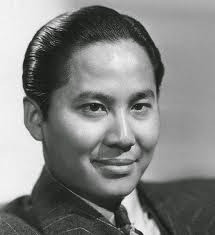
Keye Luke - Source
In addition to the positive portrayal of disability, I feel I have to note that Dark Delusion (and I'm assuming the rest of the Gillespie movies, but I haven't seen all of them) also portrays race in a positive light as well. Dr. Lee (Keye Luke) is a Chinese American doctor in Gillespie's hospital. Unlike so many Asian characters during this time period, he speaks without a pronounced foreign accent and heals based on medical facts rather than ancient "Oriental" wisdom. I will point out, however, that there is an African American staff member who speaks with an exaggerated "slave" sound (I'm not sure how else to describe it), so the movie is not completely without flaws.
 

If you would be interested in catching Dr. Gillespie in action, tune in to TCM Saturday afternoons at 1:30 pm PST during September and October.